- 59
- 1
- 0
- 0
- 0


The Verdict of the Unseen Pen
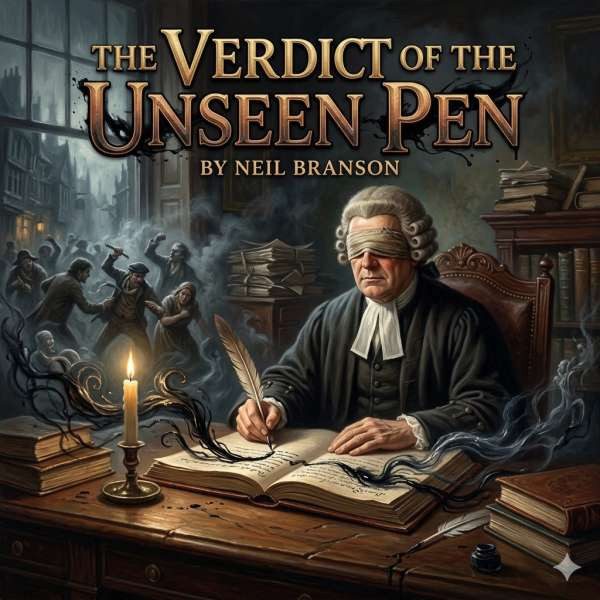
London is damp. The fog in the winter of seventeen sixty eight does not merely sit upon the river; it enters the brickwork of the houses along the Thames, clinging to wool coats and the fine grain of mahogany desks. Inside a low-ceilinged room in the heart of the city, the air carries the scent of tallow candles and damp paper. The room is quiet, save for the rhythmic scratch of a quill. Sir John Fielding sits at his desk, his eyes shielded by a heavy bandage. He is blind, yet the reports piling up on his desk demand a vision that no one else in the capital seems to possess.
London is damp. The fog in the winter of seventeen sixty eight does not merely sit upon the river; it enters the brickwork of the houses along the Thames, clinging to wool coats and the fine grain of mahogany desks. Inside a low-ceilinged room in the heart of the city, the air carries the scent of tallow candles and damp paper. The room is quiet, save for the rhythmic scratch of a quill. Sir John Fielding sits at his desk, his eyes shielded by a heavy bandage. He is blind, yet the reports piling up on his desk demand a vision that no one else in the capital seems to possess.
The Verdict of the Unseen Pen
London is damp. The fog in the winter of seventeen sixty eight does not merely sit upon the river; it enters the brickwork of the houses along the Thames, clinging to wool coats and the fine grain of mahogany desks. Inside a low-ceilinged room in the heart of the city, the air carries the scent of tallow candles and damp paper. The room is quiet, save for the rhythmic scratch of a quill. Sir John Fielding sits at his desk, his eyes shielded by a heavy bandage. He is blind, yet the reports piling up on his desk demand a vision that no one else in the capital seems to possess.
Magistrates in this city are not servants of a unified law. They are individuals, often fueled by personal grievance or local patronage, sitting in judgment over the markets and the alleys. They take fees for every warrant issued and every testimony heard. Justice is a private transaction, a commodity sold to those who can pay the price. A man stealing a loaf of bread to feed his children finds a magistrate who profits from his conviction. The city is a patchwork of competing interests where the law is not a shield, but a weapon wielded by whoever holds the bench on any given morning.
Rumors reach the magistrate’s chambers of a new kind of gathering in the streets. Merchants talk of organized theft on the docks, and the constables, underpaid and exhausted, look the other way. The pressure is mounting. The divide between the city that works and the city that takes is widening, and the current system of localized, fee-based justice is not merely failing—it is accelerating the collapse. The king's ministers speak of order, but they speak from distance, while the men on the ground know that the foundation is cracking under the weight of sheer, uncoordinated greed.
Sir John Fielding hears the movement of the city through the open window. He knows the rhythms of the thieves and the desperation of the honest. He has written of the need for a central office, a place where the law is not for sale, but for all. His brother, Henry, had once argued that a state must control its own peace, but the idea was dismissed by men who feared a standing police force as a tool of tyranny. The argument repeats in the halls of power, stale and circular. If the state takes control, they say, the liberty of the Englishman is lost. If the state stays away, the law remains a mockery.
The hinge arrives not with a shout, but with a decision to standardize the chaos. It is a rainy Tuesday. The clerk stands by the door, waiting for instruction. Fielding pauses, his hand hovering over a ledger that tracks not just crimes, but the very nature of how a crime is recorded. He knows that if he creates a record here, if he links these disparate events into a single, cohesive narrative of order, the old, decentralized world of the magistrate will cease to exist. He feels the weight of the quill. He does not know if he is building a fortress or a prison.
He dips the pen into the inkwell. He writes the name of a suspect, not for his own profit, but to build a file that will be shared across the city. This is the moment. The localized, paid-for justice of the eighteenth century is being challenged by the cold, bureaucratic machine of the state. He completes the entry. He closes the ledger. The silence that follows is not the silence of peace, but the silence of a clock having finished its winding.
The break is immediate. The men who profited from the old ways begin to lose their influence. Word spreads through the taverns and the courthouses that the rules have changed, that the records are being kept in a new, unyielding way. It is the last time a magistrate will be able to hide a conviction behind a wall of private silence. The door has closed on the era of the merchant-judge.
The shift ripples outward. In the weeks that follow, the streets grow tighter. Information begins to flow between districts as if the city were a single organism rather than a collection of fiefdoms. A thief caught in one ward is no longer a ghost in the next; he is a name in a book, a history, a repeat offender whose record is now as permanent as the ink on the page.
The consequences expand into the structure of the state itself. The model of the Bow Street Runners begins to evolve into something larger, a centralized authority that will eventually define the modern police force. It is a slow, grinding transformation, but it is inexorable. The village-style justice that had served England for centuries is stripped away, replaced by the professional, bureaucratic apparatus that will define the industrial age.
The architecture of our own lives is built upon this shift. The police officer you see on the corner, the warrants issued by a court, the record that follows a person from one city to another—this is the legacy of that winter day in seventeen sixty eight. The systems we trust to define right and wrong are not ancient, immutable truths; they are the result of a choice to trade local autonomy for a cold, centralized predictability.
When you walk through a city today, you are walking through the success of that experiment. You are surrounded by the invisible lines of jurisdiction and the silent, digital ledgers that keep the peace. It is a world of order, bought at the cost of the intimate, fractured, and deeply human mess that once was. The quill is dry. The record is complete. The city moves on, governed by the ghost of a decision made in the dark, by a man who could not see, but who saw more clearly than anyone else.
সম্প্রতি দ্বারা শোনা


কোন মন্তব্য পাওয়া যায়নি
আরো ট্র্যাক